German Civil Code: Flight booking



10+ years of experience
5 min read
Updated on
27.09.2026
Navigation to EU261/ 2004 regulation
Flight booking and cancellation under the German Civil Code
- Contract for work under the German Civil Code: A flight booking is legally considered a contract for work (§§ 631 et seq. BGB). The passenger pays the remuneration (ticket price), and the airline owes the transport as the contractual result.
- T&Cs & contractual conditions: The airline may only use terms and conditions that are clearly worded and understandable for consumers. Invalid or unfair clauses can be challenged.
- Ticket payment: Immediate payment of the full ticket price at the time of booking is legally disputed. Courts have ruled that such T&C clauses may place consumers at an unreasonable disadvantage.
- Right of termination (§ 648 BGB): Passengers may terminate the air transport contract at any time. The airline may only retain the portion of the remuneration that is not offset by saved costs or revenues. By law, it is presumed that no more than 5% of the ticket price may be retained by the airline.
- Burden of proof on the airline: If the airline wishes to retain more than 5%, it must provide detailed proof of which costs it actually saved. Without this proof, it must refund the majority of the ticket price.
- Court rulings: Several decisions – including by the Regional Court of Frankfurt/Main – confirm that airlines often unlawfully retain the full ticket price. In many cases, they were required to refund up to 95%.
- Refund of taxes & fees: Ancillary flight costs such as airport taxes, security fees, and fuel surcharges must be refunded in all cases, as they are only incurred if the flight actually takes place.
The German Civil Code significantly strengthens passengers’ rights in flight booking and cancellation. Many travelers are unaware that they are entitled to a substantial refund – even when airlines claim otherwise or state different terms in their T&Cs. Checking one’s individual claim is almost always worthwhile.
Contract for Work Law Under the German Civil Code
By booking a flight, passengers conclude an air transport contract. From a legal perspective, this is a contract for work (§§ 631 et seq. BGB).
This means:
- The passenger pays the ticket price (remuneration).
- The airline owes the transport from A to B (contractual result).
The basic principle is: “No performance, no consideration.”
Contract for work law applies unless the airline’s T&Cs provide otherwise.
T&Cs and conditions of carriage
With every booking, the customer must confirm that they have read the General Terms and Conditions or Conditions of Carriage. Pursuant to §§ 305–310 BGB, these must be understandable and drafted in German; otherwise, they do not apply. The T&Cs are therefore a central component of the air transport contract.
Right of termination in the event of ticket cancellation
Under § 648 BGB, the passenger may terminate the transport contract at any time and without stating reasons. The airline may demand the agreed remuneration but must offset saved expenses and revenues.
Important:
- Statutory presumption: The airline is entitled to a maximum of 5% of the ticket costs.
- The airline must prove which costs it actually saved.
- In practice, airlines rarely do this, yet often still retain the full ticket price.
As a result, customers often have a significantly higher right to a refund than many airlines are willing to acknowledge.
Flight ticket cancellation and refund
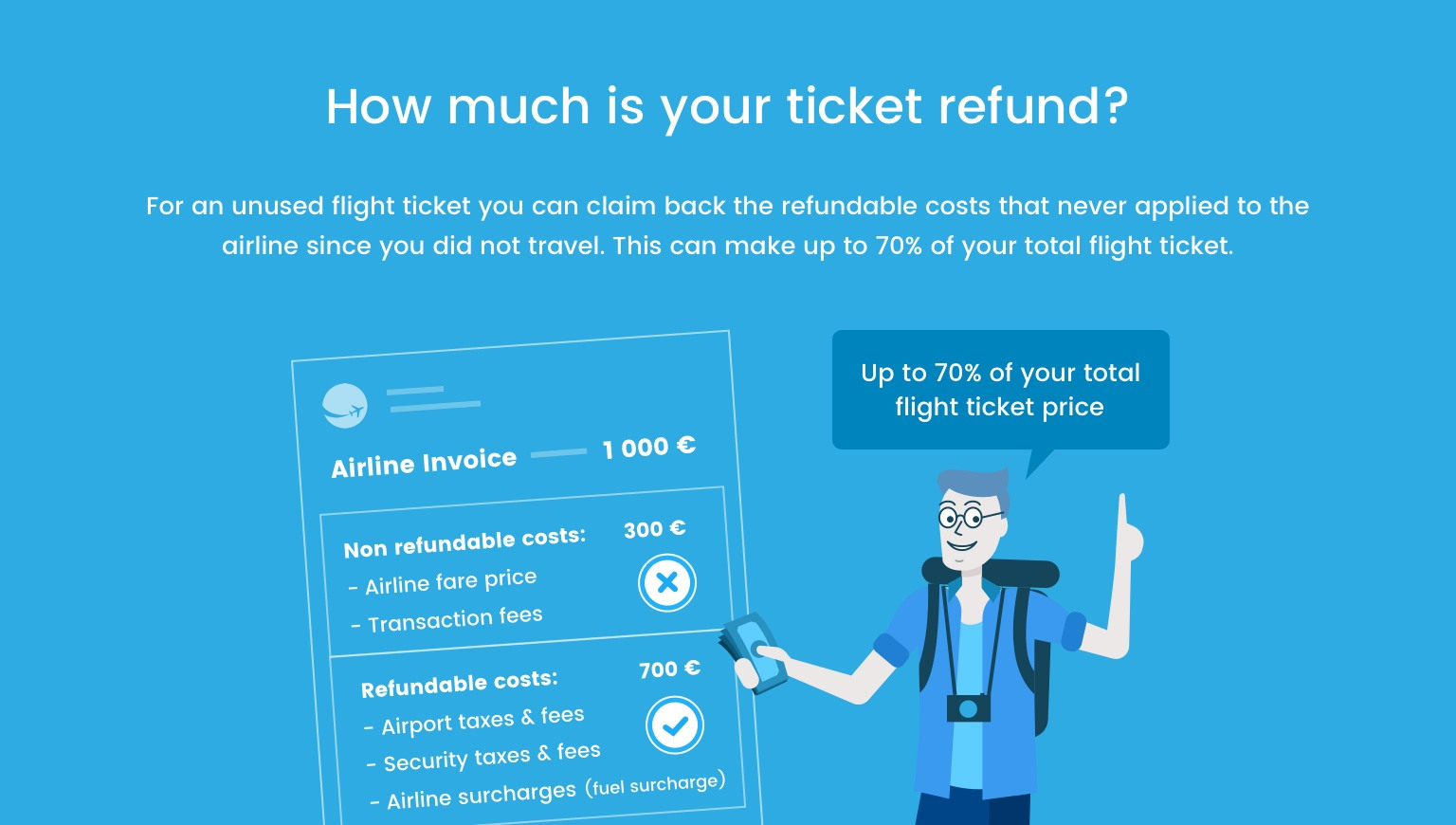
In the event of cancellation, airlines must refund all ancillary flight costs that only arise if the flight is actually taken, including:
- Airport taxes and fees
- Security charges
- Fuel surcharges (as there is no actual use)
Since taxes, fees, and surcharges can make up to 70% of the ticket price, a substantial refund claim often arises.
Flight cancellation: Exclusion in the conditions of carriage
On March 20, 2018, the German Federal Court of Justice (BGH) ruled (case no. X ZR 25/15) that airlines may stipulate a complete exclusion of cancellation in their Conditions of Carriage. In the case at issue, the plaintiffs canceled their flights due to illness and demanded a ticket refund. However, the airline refunded only taxes and fees – and the court confirmed this approach.
The reason: The customers had chosen a low-priced fare class that explicitly stated: “Cancellation of the ticket is not possible. Unused taxes and fees are refundable.”
Anyone planning long-term or needing more flexibility should therefore consider booking a fare with a cancellation option.
Limitation period for ticket refunds
Claims for refunds are subject to a limitation period of three years in Germany. Anyone who booked a ticket within the past three years and later canceled it can still assert a claim for repayment now.

The flight law experts at MYFLYRIGHT help you enforce the refund of your ticket costs. To do this, you sell us your claim and receive the corresponding amount transferred to your account within 24 hours. Each customer receives an individual purchase offer.
§ 648 BGB and ticket refund FAQ
Yes. Under § 648 BGB, the passenger may terminate the air transport contract at any time. However, the airline may only retain the portion of the remuneration that is not offset by saved costs or revenues.
Yes. All flight-dependent costs such as airport taxes, security fees, and fuel surcharges must be refunded in all cases, as they only arise if the flight actually takes place.
Yes, in part. According to a BGH ruling (X ZR 25/15), an airline may exclude cancellation in low-priced fare classes and allow only the refund of taxes and fees. It is crucial that this clause is clearly stated in the Conditions of Carriage.
The claim becomes time-barred after three years. Within this period, you can reclaim ticket costs, taxes, and fees.
Then you should send a written reminder with a deadline. If this also produces no result, you can assert your claim via MYFLYRIGHT. Enter your flight details at www.myflyright.com and we will handle the entire process for you.
Yes. You must inform the airline in writing of the termination, set a deadline, and keep all documents available. However, this can be time-consuming, especially if the airline does not cooperate.
MYFLYRIGHT ensures that your rights are enforced and takes care of all the work – with no cost risk for you.
No. Our service is completely risk-free for you. You only pay a commission if we successfully enforce your ticket refund.